
Use a Fixed Stake
I keep the same small stake for every drop instead of increasing it after a loss. A fixed stake makes the cost of 50 or 100 drops predictable and prevents one losing sequence from forcing much larger bets.

I tested Plinko as a simple arcade-style casino game: I drop a ball from the top of a pegged board and wait to see which payout slot it lands in. What I like most is how quickly the result is shown. For New Zealand players, I compared the real numbers myself — RTP, bet limits, multipliers, risk levels and payment options. My goal here is simple: show which casinos actually offer Plinko, where deposits are easy, and where the game works smoothly on mobile and desktop.
In my experience, Plinko works best because it does not overcomplicate anything. The game offers a 99% RTP, and a certified RNG controls every drop. I choose my stake, set the risk level, release the ball, and the final slot decides the payout. There is no skill pattern to force a win — every round is driven by chance.
| Feature | Details |
| 🎮 Game Title | Plinko |
| 🏢 Common Provider | BGaming |
| 👨💻 Game Type | Arcade / Specialty Game |
| 🏗️ Game Mechanic | Ball drop on a pegged board |
| 📊 RTP | 99.00% |
| ⚡ Volatility | Adjustable (depends on risk level) |
| 🎯 Max Multiplier | Up to x1000 |
| 🧱 Board Size | 8–16 rows |
| ⚠️ Risk Levels | Low, Medium, High |
| 💰 Bet Range | From NZ $0.20 per drop |
| 🔁 Auto Play | Available (optional) |
| 📱 Mobile Support | Android, iOS, Desktop |
| 🎲 Outcome Control | Fully random (RNG-based) |
My Plinko test was simple: I did not need any previous experience to understand the game. I liked that board size and risk level changed the feel of each round, while the fast drops made it easy to play on my phone or during a longer desktop session.
I selected these online casinos because they offer real-money Plinko options for New Zealand players and passed my basic checks. I looked at account security, RTP visibility, bonus rules, mobile performance and practical banking options. I also checked whether deposits and withdrawals felt clear enough before recommending a platform.








Plinko itself is easy to launch, but my experience depends heavily on the casino behind it. Before I deposit, I check three things first: whether the site looks properly licensed, whether withdrawals are explained clearly, and whether the Plinko version shows its provider, RTP and bet range.
I prefer platforms where licence info and the main rules are easy to find, not buried in the footer.
I can see the operator and licence jurisdiction
Verification steps are clear before I deposit
I prioritise casinos with fast withdrawals, clear limits, and payment methods that work well for NZ players.
Minimum withdrawal and possible fees are stated
Processing times are shown for each method
I also compare the game version itself: provider, RTP visibility, bet range and available risk tiers.
The provider is named, for example BGaming
Bet limits and max multiplier are visible
Plinko has no betting system that can predict the next drop or remove the house edge. I use strategy only to control stake size, volatility and session risk. The ball path remains random, and changing the number of rows or the risk level changes the payout distribution rather than increasing the chance of winning.
I keep the same small stake for every drop instead of increasing it after a loss. A fixed stake makes the cost of 50 or 100 drops predictable and prevents one losing sequence from forcing much larger bets.
Before playing, I divide my session budget by the number of drops I plan to make. With a NZ$20 budget and 100 drops, the mathematical maximum stake is NZ$0.20 per drop.
Low risk usually spreads more value around the centre, while high risk concentrates more of the return in rare edge multipliers. When I select high risk, I reduce the stake because short-term swings become larger.
I stop when I reach the loss limit set before the session. I also set a profit target and leave when it is reached. These limits do not improve the odds, but they stop one session from expanding indefinitely.
Doubling the stake after each loss does not change the probability of the next result. The required bet grows rapidly, so a normal losing run can hit the table limit or exhaust the bankroll before a recovery occurs.
Auto mode increases the speed at which money is wagered, not the expected return. I set a fixed number of drops and disable automatic stake increases so the session cannot continue beyond the planned budget.
Before I drop a ball, I read the payout board from the bottom up. The number of rows, selected risk level and stake determine the available multiplier pattern and the value of each result.
BGaming Plinko lets me choose between 8 and 16 rows. Each extra row lengthens the route through the pegs and creates an additional payout slot at the bottom. The ball does not pay for touching a row; only the final slot produces the multiplier.
Each bottom slot displays a multiplier. My payout for one drop is calculated as stake × landing multiplier. A multiplier below x1 returns less than the original stake, x1 returns the stake, and a multiplier above x1 produces a gross win larger than the stake.
The central slots are reached more often because there are more possible left-and-right paths leading toward the middle. The largest multipliers normally sit at the edges because reaching them requires a much less common sequence of deflections.
Low, Normal and High risk do not control the ball after it is released. They change the multiplier values assigned to the bottom slots. Low risk produces a flatter payout table, while High risk places more of the theoretical return in rare high multipliers and increases short-term variance.
Changing from 8 to 16 rows changes both the number of possible routes and the payout table shown on screen. I always recheck the multipliers after changing the row count because the available values can differ from the previous setup.
The payout is set by the slot where the ball stops. Peg contacts and intermediate rows do not create separate wins.
A NZ$1 stake landing on x5 returns NZ$5 in total. The displayed multiplier applies to that individual drop.
Selecting 8–16 rows changes the number of bottom slots and can change the multipliers available on the board.
Higher risk increases the gap between common low-value results and rare edge multipliers without removing randomness.
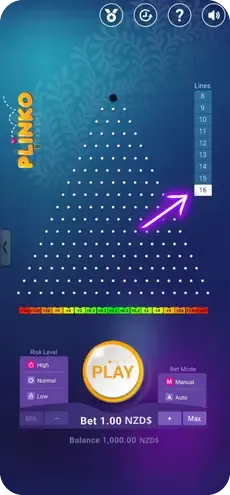
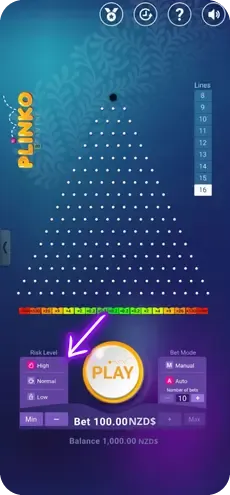
When I play the BGaming real-money version of Plinko, I set the bet, choose the risk level, adjust the number of lines and press Play. The ball drops automatically, and I cannot predict where it will land. The bottom slots hold different multipliers, so my final payout depends entirely on the result of that drop.
Instructions
I choose the value for each round using the Min and Max controls before starting the drop.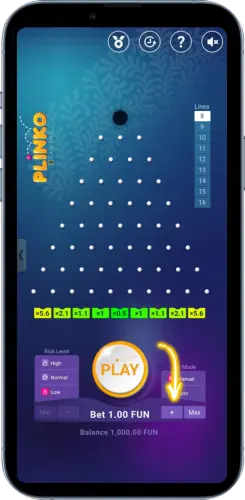
I pick Low, Normal, or High risk depending on how aggressive I want the multiplier layout to be.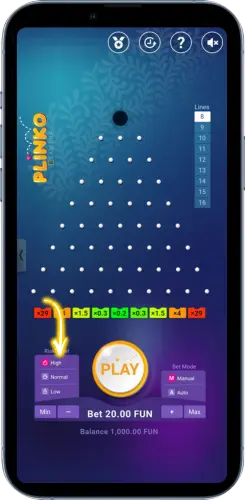
I set the number of rows on the Plinko board. More lines create a longer ball path and different payout patterns.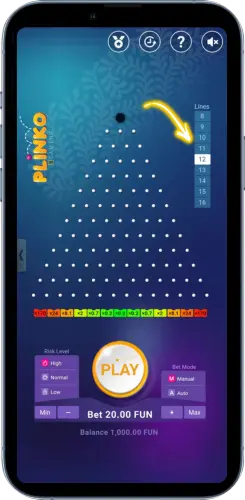
I press the Play button to release the ball onto the board and start the round.
I watch where the ball lands and then check the multiplier and total payout shown on the screen.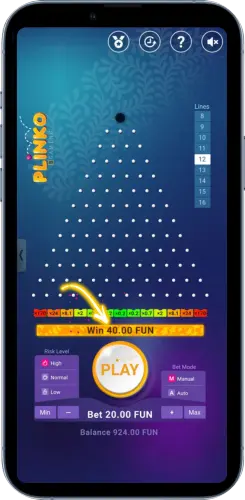
In my experience, registration usually takes about a minute. I create an account, confirm my contact details, and then open the game from the lobby.
My tip: I use real details because the platform may request identity checks later.

I log in with the same account I created during registration. After signing in, I can see my balance and open the game.
My tip: I avoid using the same password across multiple casino accounts.

I found real-money Plinko at licensed online casinos that accept New Zealand players. My minimum starting point is NZ $0.20 per drop, and my payout always depends on the multiplier where the ball lands.
Pros
I found the rules easy even for complete beginners
I get instant results after each ball drop
Risk levels let me adjust the gameplay style
The bet and multiplier system is clear to me
I can switch between demo and cash play options
The game works well for me on mobile and desktop
Cons
I cannot control the final result
High-risk setups reduce my win frequency
High variance makes longer sessions unpredictable
Before I place real-money bets, I always check how the casino handles fair play, account safety and player protection. These are the three points I look for first on New Zealand-friendly platforms.
I look for licensed casinos because they are expected to handle payouts, ID checks and support properly.
I can find the site owner and licence details
The terms explain cash-out and KYC rules clearly
I prefer Plinko versions that use tested software where every round is independent from the previous one.
Every ball drop is random
The game studio works separately from the casino site
I value casinos that give me built-in tools to manage my budget and playing time.
I can set deposit, loss and time limits
Account history and self-exclusion tools are easy to find




Bonus up to 1,000 NZD + 200 FS
Claim bonus